An international curriculum in early childhood education is not about making young children learn advanced concepts too early. It is about giving them a wider way to observe, question, communicate, and understand the world around them. In the early years, when brain development, language growth, sensory learning, and social awareness are rapidly taking shape, the right curriculum can influence how children build curiosity, adaptability, and confidence.
A Wider Way Of Seeing Things
One of the strongest benefits of an international curriculum is that it helps children understand that the world is not limited to one culture, one language, or one way of thinking. In early childhood, this may happen through stories from different countries, songs, greetings, classroom displays, simple map activities, or conversations about how families live in different places.
These experiences build the early foundation of intercultural intelligence. Children begin to notice difference without fear or judgment. They learn that people may speak differently, celebrate differently, eat differently, or solve problems differently, and that all of this can be understood with curiosity.
Learning Through Inquiry, Not Pressure
In the early years, children learn best when they can touch, observe, ask, repeat, and explore. This is connected to neuroplasticity, the brain’s ability to form new connections through repeated experiences. A child who sorts objects, listens to a story, asks why leaves fall, or builds a tower again after it collapses is not “just playing.” They are developing attention, memory, reasoning, and problem-solving.
Communication Skills Grow Through Everyday Interaction
Early childhood is also an important period for language acquisition. When children hear new words, listen to stories, sing songs, describe objects, and speak with peers, they begin building vocabulary, expression, and confidence. In an international curriculum for preschool, multilingual exposure can also help children become more aware of sounds, meanings, and cultural context.
Something else that often gets overlooked is how children begin to express themselves. A global curriculum for early childhood usually gives space for children to speak, share, and even disagree in simple ways. It’s not about teaching debate. It’s more about letting them feel heard. Over time, they become a bit more comfortable putting their thoughts into words. That confidence builds quietly, without much pressure.
What Parents Should Look For In An Early Years Curriculum
When looking at options like the best preschools in Hyderabad, things can feel a bit overwhelming. Many schools talk about international methods, but what matters more is how it actually feels inside the classroom. At Slate – The School, one of the best preschools in Hyderabad, we try to mix structured learning with open-ended exploration. It’s not about doing everything perfectly, but about creating an environment where children are not rushed into growing up too quickly.
How An International Curriculum Builds Life Skills
An international curriculum supports life skills because it gives children repeated chances to explore, decide, create, and reflect. A child working on a group activity learns cooperation. A child explaining a drawing builds communication. A child trying a puzzle again after failing develops resilience. A child listening to a story from another culture builds empathy and perspective.
How SLATE Brings This Approach Into Early Learning
At Slate – The School, this approach is reflected through a balance of structured learning, open-ended exploration, values, creativity, and future-ready exposure. The Sampoornatha program supports life skills and whole-child growth, while the SMAART program introduces children to emerging areas such as technology, robotics, and advanced thinking in an age-appropriate way. The Cambridge Curriculum gives children space to ask questions, understand concepts, and build independent thinking without being rushed through learning.
As one of the best preschools in Hyderabad, we use the Cambridge Curriculum as it allows our children to think independently, pose questions, and understand concepts rather than merely rushing through them as part of a prescribed syllabus. Alongside this, our Trayoda ‘C’ values are embedded as a part of every learning experience to instill character as much as competence. For us, it has never been about doing more. It has always been about doing what truly matters for a child’s future.
Why The Early Years Matter For Brain Development
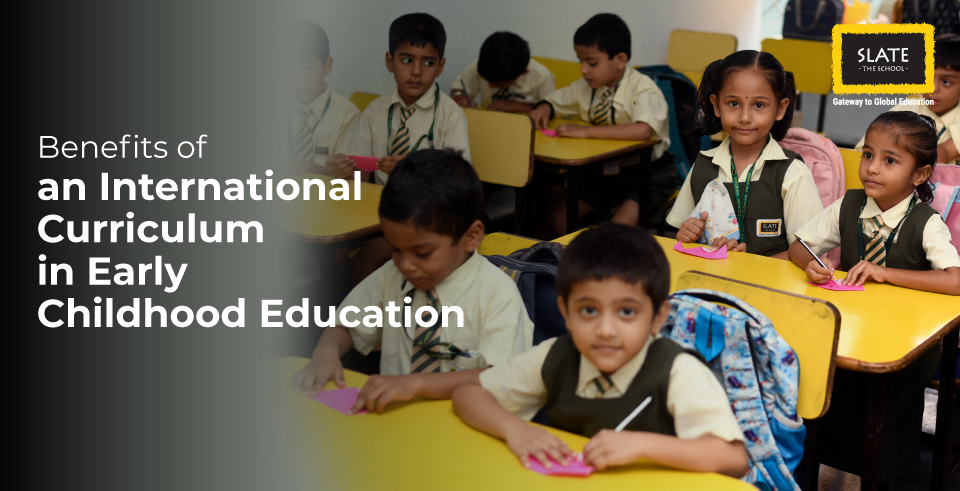
Early childhood is a period of rapid cognitive, emotional, social, and language development. During these years, children learn through sensory experiences, movement, repetition, play, and conversation. This is why early education should not depend only on worksheets or memorisation.
Exploratory learning helps children build neural connections through real experiences. When they touch materials, compare shapes, listen to sounds, narrate stories, or ask questions, they are strengthening attention, memory, language, and reasoning. An international curriculum works well in early childhood when it respects this developmental stage instead of pushing children into formal academics too early.
Final Thoughts
In the end, an international approach isn’t really about making a child “ahead.” It’s more about giving them a wider, gentler start. They begin to understand that the world is bigger than what they see every day. They learn that questions are okay. And maybe most importantly, they hold on to their curiosity a little longer, which feels like the part that matters most.