
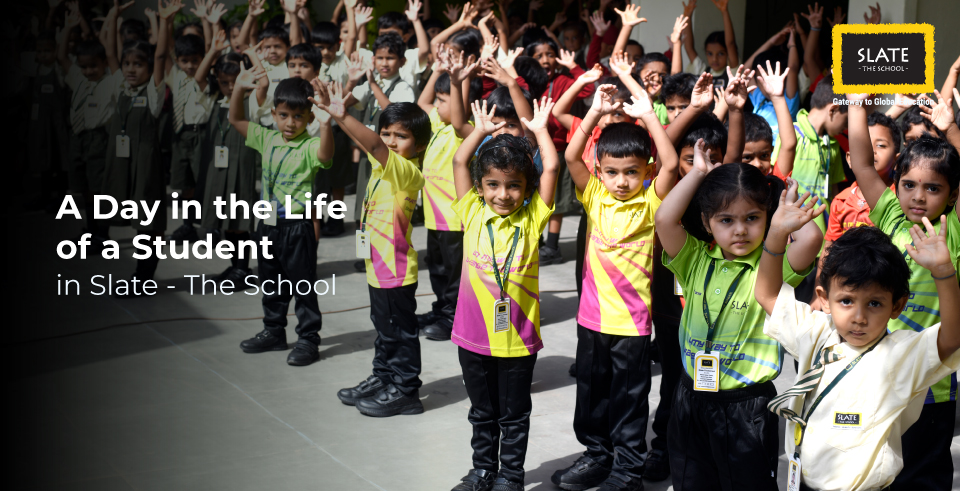
A day at Slate – The School begins with familiar faces, classroom greetings, morning conversations, and children settling into the rhythm of learning. Some walk in discussing yesterday’s activity. Some carry questions from home. Some need a few minutes before they are ready to participate. The day is structured, but not rushed. Children are given time to arrive not just physically, but mentally and emotionally too.
Learning That Doesn’t Feel Forced
In a Cambridge Curriculum classroom, this may look like students comparing two ways to solve a math problem, explaining a science observation in their own words, or presenting a short response after a reading activity. A teacher may ask, “How did you reach that answer?” instead of only checking whether the answer is right. This kind of questioning builds reasoning, communication, and confidence.
The Part Where Children Become More Than Students
There is a moment in the day when academics take a step back, and something else takes over. It could be a life skills session where students discuss how to respond when a group activity does not go their way. It could be a classroom conversation about responsibility, empathy, or handling disagreement. It could be a peer activity where children practise listening before replying. These moments may not look like traditional academics, but they build emotional intelligence, communication, and resilience.
A Different Kind Of Future Taking Shape
Sometime later in the day, things shift again. The SMAART Program brings in a different energy. There’s curiosity, but also a sense of building something for tomorrow. Students are not just introduced to technology; they are made comfortable with it. Artificial intelligence and robotics are not distant concepts. They slowly become part of how children see the world. And yet, there is a balance. Technology is not allowed to take over completely. There’s a clear boundary, even with things like smartphones, because focus is treated as something fragile and worth protecting. It’s a careful balance, and it doesn’t try to impress. It just works quietly.
In one corner, students may be discussing why a robot did not move the way they expected. Another group may be testing a simple logic sequence, adjusting an instruction, or asking how AI recognises patterns. The room has energy, but it is not chaotic. Children are learning that technology is not magic. It is something they can question, design, test, and improve.
The Values That Stay In The Background
Not everything in a school day is visible. Some things sit in the background, shaping how children behave without being pointed out directly. Trayoda ‘C’ is one of those things at SLATE – The School. It may show up when a child lets another student complete an answer, when a team captain includes a quieter classmate during a game, or when students take responsibility for materials after an activity. These are not separate moral lessons. They are daily practices that shape discipline, confidence, compassion, and character.
Where Movement, Art, and Expression Enter The Day
A school day also needs space for movement and expression. On the playground, children learn teamwork, patience, leadership, and how to recover after losing a game. In an art or music session, they learn to observe, create, and express what they may not always say in words. These moments give balance to the day. They also build confidence, social awareness, and creative thinking.
Ending The Day Without Rushing It Away
By the time the day comes to an end, it doesn’t feel like something to escape from. There’s no sudden break from stress, because the day wasn’t built on stress to begin with. Children leave with something more than completed work. Maybe it’s a question they’re still thinking about, or something they understood a little better about themselves. Parents who look beyond marks often begin to notice this difference. That’s perhaps why Slate -The School is often spoken about not just among the best schools in Andhra Pradesh and Telangana, but as a place where education feels more complete.
Final Thoughts
When you think about it slowly, a day at our school is not extraordinary in obvious ways. There are classes, activities, and routines, just like any other school. But the difference lies in how everything connects. Nothing feels random. Nothing feels rushed. There is a sense that every part of the day is working towards something bigger, even if it’s not immediately visible. And maybe that’s the point. The future doesn’t really belong to children who are just taught well. It belongs to those who are prepared, quietly and steadily, for a world that hasn’t fully arrived yet. That preparation doesn’t happen in one big moment. It happens across ordinary days like these.