
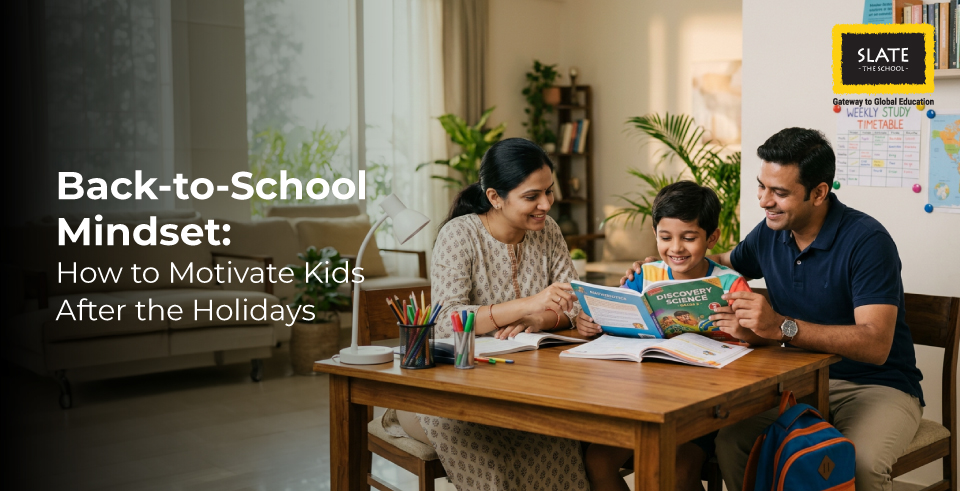
There’s always that quiet shift after the holidays. The days feel slower at first, then suddenly rush. Mornings become stricter. Bedtimes matter again. And children, who were just laughing freely a few days ago, now seem unsure about stepping back into routine. It’s not really about laziness. It’s more like a pause that got too comfortable.
A child doesn’t think, “I don’t want to study.” It’s closer to, “Why does this feel so different again?” That small confusion often gets mistaken for resistance. And that’s where most of the struggle begins when thinking about how to motivate kids after holidays.
The Mood No One Talks About
There’s a kind of quiet resistance children carry when school reopens. Not loud complaints always, but small things. Taking longer to get ready. Losing interest quickly. Asking for “just five more minutes.” It helps to see this as a transition, not a problem.
At SLATE The School, we often notice that children respond better when this phase is handled gently, not with urgency. Because pushing too hard, too soon, tends to create more distance from learning instead of bringing them closer. The idea isn’t to fix the mood overnight. It’s to understand it first.
Starting Small Feels Less Heavy
Big expectations rarely work right after a break. A child who was free for weeks cannot suddenly switch into full academic mode. It feels unnatural. That’s why easing into a back to school routine for kids matters more than enforcing it strictly, like a slightly earlier bedtime, a simple morning rhythm. Maybe even talking about school in a light way, not as a task waiting to be completed, but as a place they belong to again.
At SLATE The School, we shape routines in a way that doesn’t feel forced. Classrooms are designed to feel welcoming, not demanding. It’s a small difference, but children notice it more than adults think.
Motivation Doesn’t Always Look Like Motivation
There’s a common idea that motivation should look energetic and obvious. But with children, it’s quieter. Sometimes it looks like curiosity returning slowly. Sometimes it’s just showing up without resistance. When thinking about how to motivate kids to go to school, it helps to move away from rewards and pressure. Instead, it’s about helping them reconnect with what feels familiar, like a friend they like, an activity they enjoy, a teacher who understands them. At SLATE The School, learning isn’t built only around textbooks. With activities like arts, sports, music, and field experiences, children often find their way back to school not because they “have to,” but because something there feels meaningful again.
The Space Between Study And Interest
Children rarely respond well to study when it feels isolated. Books alone don’t always create engagement. That’s where the question shifts from forcing study to understanding how to motivate a child for study in a way that feels natural. Sometimes, it’s about connecting lessons to real things. Sometimes, it’s about letting them ask questions instead of just answering them. Our approach at SLATE The School reflects this balance.
Through the SMAART Program, children explore areas like science, robotics, and technology in ways that feel hands-on and alive. Learning becomes something they experience, not just complete. And slowly, without much force, interest builds again.
When School Feels Like More Than School
A child is more likely to return willingly to a place that feels whole. Not just academics, but movement, expression, friendships, and moments that aren’t measured. This is often missed when thinking about back to school tips for kids. The focus goes straight to discipline and study, skipping over the environment that supports both.
At SLATE The School, everything from classrooms to play areas is built to support this balance. Dance halls, libraries, science labs, open spaces, these are not extras. They’re part of how children reconnect with school life. Because when a child feels comfortable, learning follows more naturally.
Encouragement That Doesn’t Feel Like Pressure
There’s a thin line between encouraging and pushing. Children can feel the difference instantly. Telling them to study harder rarely works. Sitting beside them, asking what feels difficult, or even just listening, that works better. Understanding how to motivate child for school often comes down to this simple shift, less instruction, more presence. The same applies when thinking about how to encourage a kid to study. It doesn’t always need strategies or systems. Sometimes, it’s just about creating a space where they don’t feel judged for struggling.
At SLATE The School, teachers are trained to notice these moments. Not every child needs the same approach. Some need guidance. Some need time. And some just need to feel understood.
The Role Of Structure Without Rigidity
Structure helps. But only when it doesn’t feel rigid. A predictable day can bring comfort after the unpredictability of holidays. But if every minute feels controlled, children tend to resist it. That’s why the idea of how to motivate a child for school is closely tied to how flexible the routine feels. At SLATE The School, routines exist, but they allow space for creativity and exploration. Learning isn’t rushed. It’s guided. And that difference often decides whether a child adapts or withdraws.
A Place Where Children Settle Back Naturally
At SLATE The School, the return to routine is not treated as a sudden shift but as a gradual settling. The environment is thoughtfully designed so children feel comfortable stepping back into learning without pressure. With the Cambridge curriculum, experienced teachers, and spaces that encourage curiosity, the focus stays on balance.
Programmes like SMAART and Sampoornatha quietly support both thinking and emotional growth. Here, school does not feel separate from life. It becomes a space where children ease back into rhythm, reconnect with learning, and slowly find their confidence again after the holidays.
Final Thoughts
Getting back to school after holidays isn’t just about restarting studies. It’s about readjusting emotions, energy, and expectations. Children don’t need perfect plans. They need time, understanding, and a space that feels right. When routines return gently, when learning feels connected to real life, and when encouragement replaces pressure, something shifts quietly. The resistance fades. The rhythm comes back.
At SLATE The School, this transition is treated with care because it’s not just about academics. It’s about helping children feel ready again, in their own time. And maybe that’s what matters most. Not rushing the process, but trusting that children find their way back when the path feels steady enough to walk on.