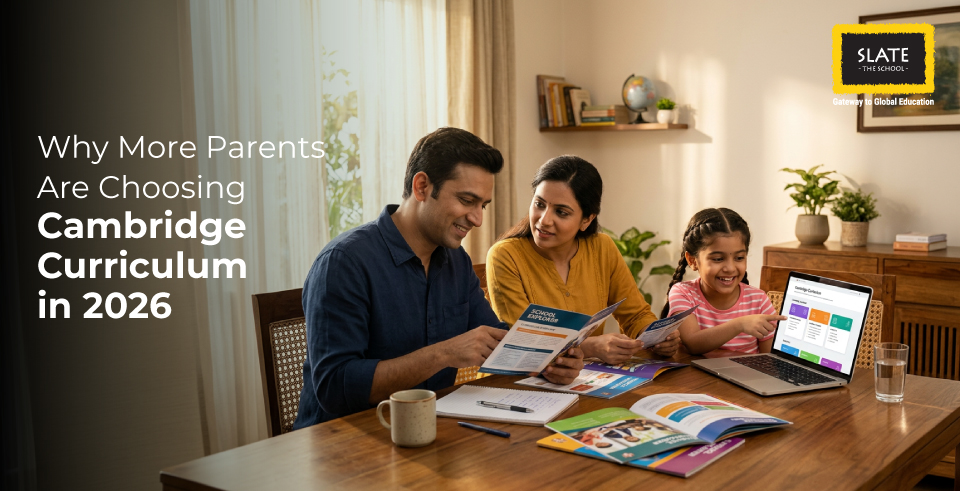
There’s been a small but noticeable shift in how parents are thinking about school in 2026. Not loud, not dramatic, but steady. Conversations sound different now. They are less about marks, more about whether a child understands what they’re learning, less about “finishing the syllabus,” more about whether the child is actually curious. Somewhere in the middle of all this, the Cambridge curriculum keeps coming up. Not as a trend, but almost as a quiet answer people arrive at after thinking things through. It doesn’t feel like a sudden decision, more like something that slowly starts to make sense.
It’s Not Just About Studying More
One thing that seems to bother parents now is the idea of children studying a lot but not really knowing how to use what they’ve learned. It’s that gap that’s hard to ignore. The Cambridge international curriculum seems to approach this differently. It doesn’t rush children through chapters just to say they’re done. It lets them sit with ideas a bit longer, question them, sometimes even struggle with them. And maybe that struggle is the point. Because when a child figures something out on their own, even if it takes longer, it sticks in a way memorised answers don’t.
The World Feels Bigger Now
There’s also this quiet awareness that the world children are growing into isn’t limited anymore. Opportunities, careers, even problems, they don’t belong to one place. Parents seem to be thinking ahead. Not in an anxious way, but in a practical one. They want their children to be comfortable thinking beyond boundaries.
That’s where this question keeps coming up: why choose the Cambridge curriculum when there are so many options? The answer isn’t always immediate, but it often circles back to this idea of global readiness. Not just in terms of academics, but in how a child thinks, communicates, and adapts.
Learning Feels Different Here
At SLATE The School, this shift is something we’ve been paying attention to for a long time. Not because it’s trending, but because it’s real. We’ve seen that children learn better when the environment feels thoughtful.
Not just classrooms, but everything around them. The way lessons are taught, the way teachers interact, even the small things like how a space feels when a child walks into it. Our approach isn’t about adding more to a child’s plate. It’s about making what’s already there more meaningful. So learning doesn’t feel like something forced. It feels like something that unfolds.
Not Just Academics, Something More
There’s also this quiet realization among parents that school shouldn’t only be about subjects. Children are not just students. They’re still figuring out who they are. That’s why at SLATE The School, the focus goes beyond textbooks. Activities like sports, music, arts, and even simple group interactions aren’t treated as extras.
They’re part of the learning itself. Because confidence doesn’t come from marks alone. It builds slowly, through experiences, small wins, and sometimes even failures.
Where Curiosity Meets Structure
One interesting thing about the Cambridge curriculum is that it doesn’t remove structure, but it doesn’t make it rigid either. There’s space to learn, but also enough guidance to not feel lost. At SLATE, this balance becomes even more important.
Our teaching methods are designed to help children ask questions without feeling unsure about where they’re headed. And over time, something shifts. Children don’t just wait for answers. They start looking for them.
Preparing For What Doesn’t Exist Yet
This part is harder to explain, but it seems to matter more now than ever. The future children are heading into isn’t fully clear. New careers keep appearing. Technology keeps changing things faster than expected. So the question is no longer just “What should a child learn?” but “How should a child learn?” That’s where programs like SMAART come into the picture at SLATE The School.
It’s not just about subjects like Science or Mathematics. It goes deeper into areas like Artificial Intelligence, Robotics, and even how human behavior connects with technology. Not in an overwhelming way. But in a way that slowly builds familiarity. Because when something feels familiar, it becomes less intimidating.
A Place That Thinks Ahead
There’s a reason why parents looking for the best Cambridge school in Hyderabad often pause and look closer at what we offer. At SLATE The School, the focus has never been just on keeping up. It’s been thinking ahead, but carefully. Our classrooms, our programs, even the way teachers are trained, everything is built with the idea that children need more than just information. They need clarity, confidence, and the ability to handle change. And that doesn’t happen overnight. It grows, step by step.
Small Things Parents Notice
Sometimes, it’s not the big features that convince parents. It’s the smaller things. A child explaining something in their own words. Asking questions that don’t come from a textbook. Showing interest in things outside their syllabus. These moments are easy to miss, but they matter. They quietly answer the question many parents start with.
A School That Grows With The Child
At SLATE The School, the idea has never been to fit children into a system, but to shape the system around how children actually learn. We pay attention to how each child thinks, responds, and grows over time. The classrooms are not rushed spaces; they are steady, guided environments where learning feels natural.
With programs like SMAART and a strong foundation in the Cambridge curriculum, we try to prepare children not just for exams, but for life as it unfolds. It’s a quiet, consistent effort to make education feel relevant, balanced, and real every single day.
Final Thoughts
Parents are not just choosing a curriculum. They’re choosing a way of learning that feels more in tune with the world their children are growing into. The Cambridge international curriculum fits into this because it doesn’t try to rush learning. It allows it to develop naturally, but with direction.
At SLATE The School, this idea is something we live every day, not perfectly, but thoughtfully. And maybe that’s enough. Because in the end, the decision doesn’t come down to what looks better on paper. It comes down to what feels right when you imagine your child growing up in that environment. And more parents, quietly, seem to be arriving at the same place.