When people talk about holistic development, it often sounds like a promise rather than a lived experience. At Slate, we’ve learned over time that holistic growth doesn’t come from adding more layers to education. It comes from slowing down enough to notice the child behind the timetable. The Cambridge framework appealed to us for this exact reason. It doesn’t demand that children fit into a rigid structure. It allows learning to move with them. The Cambridge curriculum doesn’t feel like something imposed from the outside. It blends quietly into everyday classroom life. It respects how children think, how they speak, and how they slowly make sense of the world. That respect is where real development begins.
Letting Learning Feel Connected
Children are naturally curious, but they are also quick to sense when learning feels disconnected from life. One isolated lesson after another can make even the most curious child withdraw. What we appreciate about the Cambridge approach is how it encourages connections without forcing them. At Slate, learning rarely feels like a set of separate subjects competing for attention. A discussion in class may begin with a story, turn into a question, and later show up again during an activity or project. This sense of continuity helps children understand that learning is not something that starts and stops with a bell. This is a quiet but powerful part of the international curriculum’s holistic learning, where understanding grows through relationships between ideas, not just repetition.
Language That Grows Naturally
Language development is one of the earliest windows into how a child is learning. We’ve always believed that strong communication isn’t built through pressure. It grows through exposure, use, and confidence. The Cambridge curriculum places language at the centre, but without turning it into a burden. In our classrooms, children encounter rich vocabulary as part of their everyday experience. Words come through stories, classroom conversations, questions, and even disagreements. Over time, children don’t just learn new words. They learn how to use them, how to think with them, and how to express themselves clearly. This is one of the most meaningful Cambridge curriculum benefits for students, because communication becomes a life skill rather than a subject to complete.
Why the Early Years Matter So Much to Us
There is something unique about the early and primary years. Children are open, curious, and far less afraid of being wrong. This is when foundations are formed quietly, without effort or fear. That is why we offer the Cambridge curriculum specifically at this stage. At Slate, we see these years as a time to strengthen language, curiosity, and confidence. Children at this age absorb accents, vocabulary, and patterns almost effortlessly. Introducing them to an internationally benchmarked curriculum now gives them a natural ease with learning that stays with them later, especially in global environments. As children grow older, their needs change. Learning must then go deeper into application, emotional understanding, and real-world thinking. That is when we transition from Cambridge to our own SMAART curriculum, which builds on the foundation Cambridge helps create rather than replacing it.
Learning Beyond Books, Without Making It Obvious
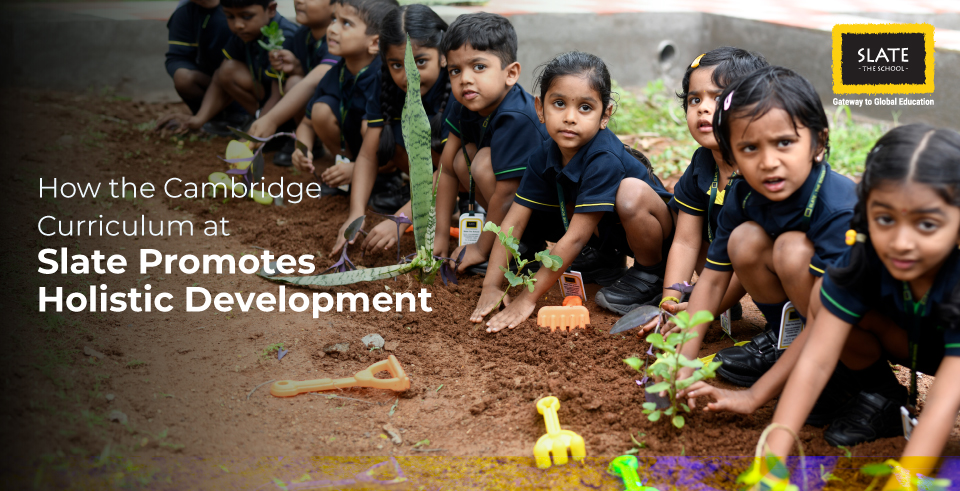
Holistic development isn’t something we announce to children. It happens through experience. At Slate, academics move alongside activities without one overshadowing the other. Sports, arts, music, movement, and life skills are not treated as rewards for finishing “real work.” They are part of real work. A child learns patience during a craft activity, confidence during a performance, teamwork during a game, and stillness during yoga. These moments shape children as deeply as any lesson. They learn how to exist with others, how to manage emotions, and how to stay curious. This balance is intentional, but it never feels forced.
Preparing for a Changing World, Gently
The future children are stepping into is complex and constantly shifting. Preparing them doesn’t mean overwhelming them with information. It means helping them become comfortable with change and problem-solving. Our SMAART Program grows naturally from this philosophy. Early exposure to questioning and exploration helps children later engage with ideas like science, technology, and behaviour without fear. Introducing the basics of artificial intelligence in Grades 3, 4, and 5 is not about rushing children ahead. It’s about familiarity. About helping them see technology as something they can understand and question, not just consume. Learning, when approached this way, doesn’t feel like training for something distant. It feels relevant and alive.
Teachers Who Teach, Not Just Deliver
Curriculum sets the direction, but teachers shape the journey. The Cambridge framework allows educators the freedom to respond to what they see in the classroom. At Slate, our teachers are trained to observe closely. They notice when a child hesitates, when curiosity sparks, and when confidence begins to grow. This responsiveness creates a learning environment that feels personal without isolating children. They are guided rather than pushed, supported rather than compared. Over time, children develop a steady confidence. Not the loud kind, but the kind that stays with them when things get challenging.
Spaces That Support Learning
The environment plays a quieter role in education, but it matters deeply. At Slate, classrooms, libraries, labs, play areas, and creative spaces are designed with intention. A library invites exploration, a lab invites questions, and a play area invites movement without chaos. Even sensory walkways remind children that learning involves the whole body. These spaces reflect our belief that education is not just mental work. It is physical, emotional, and social too. When the environment supports this balance, children feel safe enough to learn and grow.
Why Families Choose This Path With Us
Choosing a curriculum is not just an academic decision. It shapes how a child experiences learning itself. At Slate, the Cambridge curriculum is not simply followed. It is lived, adapted, and aligned with our values.
Children are encouraged to think, question, and express themselves. They are not trained to memorise and repeat. They learn to connect ideas to everyday life, to listen to others, and to form opinions thoughtfully. This approach is one of the reasons families recognise us as Slate – The School: Best Cambridge curriculum schools in Hyderabad, not because of titles, but because of the way learning feels day after day.
Final Words
Holistic development is not about doing everything at once. It’s about doing what matters, at the right time, with care. The Cambridge curriculum at Slate works because it respects childhood, values connection, and trusts the learning process. Children leave the early years with more than knowledge. They leave with curiosity, confidence, and a sense that learning belongs to them. As they move forward into deeper academic and life learning, they carry a foundation that supports them quietly but firmly. That, to us, is what meaningful education looks like when it is lived, not claimed.