
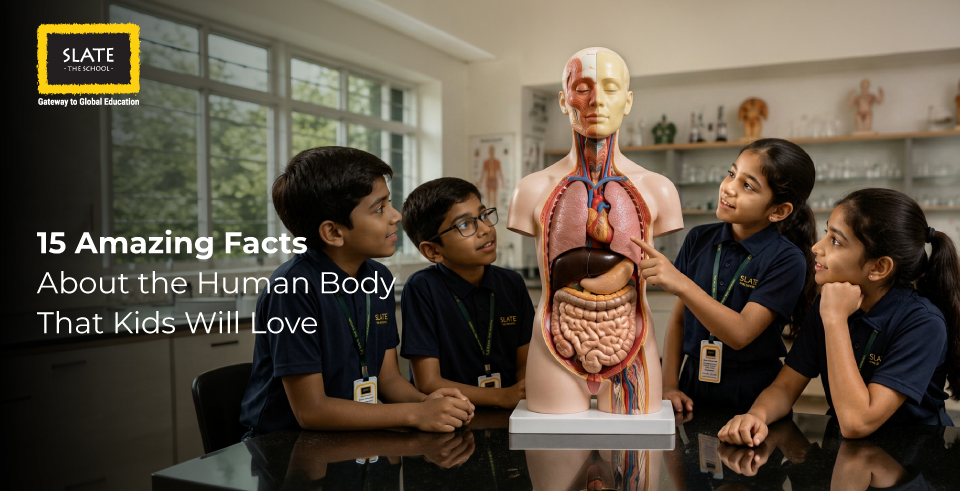
The human body is like a tiny world of its own. Every second, thousands of things are happening inside us without us even thinking about them. Our heart keeps beating, our lungs keep helping us breathe, our brain helps us learn, and our bones give us the strength to move.
For children, learning about the body can be much more exciting when it starts with simple questions: How does our heart know when to beat? Why do we blink? Why do we get goosebumps? How can our bones heal themselves?
Here are 15 incredible human body facts that can help children discover just how interesting their own bodies are.
1. Your heart beats thousands of times every day
Your heart is one of the hardest-working organs in your body. It keeps pumping blood around your body all day and night, even while you are sleeping.
Blood carries oxygen and nutrients to different parts of your body and helps carry away things your body does not need. Your heart never takes a proper day off!
2. Your brain is the control centre of your body
Your brain helps you do almost everything. It helps you think, remember things, learn new skills, move your body, understand sounds and sights, and even control things you do without thinking.
For example, you do not have to remind yourself to breathe every few seconds. Your brain helps manage many such activities automatically.
This is one of the most amazing facts about the human body because the brain is constantly receiving and sending messages throughout the body.
3. Your bones are stronger than you may think
Bones may look hard and lifeless, but they are living parts of your body. They contain cells, blood vessels and nerves.
Your skeleton gives your body shape and protects important organs. Your skull protects your brain, while your ribs help protect your heart and lungs.
Children also have more bones than adults. Some bones join together as we grow, which is one reason babies have more bones than grown-ups.
4. Your skin is your body’s biggest organ
When you think about organs, you might think about the heart, brain or lungs. But your skin is actually the largest organ in your body.
It covers and protects you from the outside world. It also helps you feel things such as heat, cold, pressure and touch.
Your skin is also constantly changing. Old skin cells fall away and are replaced by new ones.
5. You blink without even thinking about it
Have you ever tried not to blink? It can become uncomfortable very quickly.
Blinking helps spread tears across your eyes and keeps them moist. It also helps remove tiny particles that may get into your eyes.
You blink many times throughout the day, often without even noticing. This makes blinking a great example of how your body can do important jobs automatically.
6. Your lungs work every moment you are alive
Every time you breathe in, your lungs take oxygen from the air. When you breathe out, your body gets rid of carbon dioxide.
Your lungs work while you run, play, sleep, read or sit quietly. When you exercise, your body needs more oxygen, so your breathing becomes faster.
This is one of the most interesting facts about the human body for kids because something as simple as breathing is actually a carefully controlled process.
7. Your stomach uses acid to digest food
Your stomach does more than simply hold the food you eat. It produces digestive juices, including stomach acid, that help break food down.
The food then moves through your digestive system, where your body takes useful nutrients from it.
Your stomach has a special lining that helps protect it from its own acid. Pretty clever, right?
8. Your fingerprints are unique
Look closely at your fingertips. You will see tiny lines and patterns.
These are your fingerprints, and they are different from those of other people. Even identical twins do not have exactly the same fingerprints.
That is why fingerprints can be used to identify people. You have been carrying your own unique pattern with you since before you could even talk.
9. You have a whole army protecting you
Your body has an immune system that helps protect you from harmful germs.
When germs such as certain bacteria or viruses enter your body, your immune system works to recognise and fight them. White blood cells are an important part of this defence system.
So, while you may not see it, your body is constantly working to keep you safe.
10. Your tongue helps you do more than taste
Your tongue helps you taste food, but that is not its only job.
It also helps you move food around your mouth while chewing and helps you swallow. Your tongue also plays an important role when you speak.
Try saying a sentence without moving your tongue. It is much harder than you might expect!
11. Your body can repair itself
Got a small cut or scrape? Your body immediately starts working to repair the damaged area.
Blood helps form a clot to stop bleeding, while other cells help repair the skin. Over time, the wound can heal.
This does not mean every injury heals completely on its own, of course. But the body’s ability to repair many everyday injuries is one of the most amazing facts about the human body.
12. Your muscles help you move, smile and even breathe
Your body has hundreds of muscles. They help you walk, jump, run, pick things up and even make facial expressions.
Some muscles work when you decide to move. Others work automatically. For example, your heart is a muscle that keeps working without you having to tell it to beat.
So the next time you smile, remember that your body is using muscles just to make that happen.
13. Your ears help you balance
Your ears do not only help you hear sounds. Parts of your inner ear also help your brain understand your body’s position and movement.
This helps you stand, walk and move without constantly falling over.
Try standing on one foot. Your ears, eyes, muscles and brain are all working together to help you stay balanced.
14. Goosebumps are an old body response
Have you ever felt tiny bumps appear on your skin when you are cold or scared?
Those are goosebumps.
They happen because tiny muscles connected to hair follicles tighten. In animals with lots of body hair, this can help trap warm air or make the animal look bigger. In humans, it is mostly a leftover response from our earlier ancestors.
So even something as small as goosebumps has a story behind it.
15. Your body is always changing as you grow
A child’s body does not stay the same. Your bones become bigger, your muscles become stronger and your brain continues to develop as you learn and experience new things.
This is why children need good food, enough sleep, physical activity and time to play. All of these support a healthy body and help children learn better.
Understanding your body can also encourage children to take better care of themselves.
Why Learning About the Human Body Matters
These facts about the human body for kids are not just fun pieces of information. They can help children become more curious about science and understand how the things they learn in class connect to everyday life.
Instead of simply memorising names of organs, children can ask questions, observe what happens around them and understand why their bodies behave in certain ways.
For example, learning about the lungs can lead to questions about exercise and breathing. Learning about muscles can make children think about sports and movement. Learning about the brain can open conversations about sleep, memory and learning.
This is where the way children learn becomes important.
How SLATE – The School Makes Learning More Practical
A school should not make science feel like a list of facts that children have to remember for an exam. Children learn better when they are encouraged to ask questions, understand ideas and connect lessons with real life.
SLATE – The School follows an approach that focuses on understanding, curiosity and learning beyond textbooks. Its academic approach includes activities such as sports, arts and crafts, yoga, swimming, music, field trips, cultural activities and life-skills classes alongside academics.
SLATE also focuses on helping students understand concepts rather than simply recall information. Its Cambridge curriculum approach encourages children to ask questions, explore ideas, communicate and develop problem-solving skills.
This makes topics such as the human body a great opportunity for children to learn through observation and discussion. A lesson about the heart can become a conversation about exercise. A lesson about muscles can connect with sports. A lesson about the brain can lead to discussions about sleep, memory and learning.
SLATE – The School was established in 2001 and follows a value-based approach to education, with the school officially affiliated with CBSE, ICSE and Cambridge boards. Its wider philosophy focuses on preparing children not only for academics but also for life.
The school’s TRISHUL framework also brings together academics, communication, confidence, emotional resilience, human values and real-world life skills.
Keep Asking Questions
The human body is full of surprises. From a heart that keeps beating to a brain that helps us learn, from bones that support us to an immune system that protects us, our bodies are doing incredible things every minute.
The best part is that children do not need a complicated textbook to start exploring these ideas. They can begin with simple questions about themselves.
Why does my heart beat faster when I run?
Why do I breathe faster after playing?
Why does a cut heal?
Why do I blink?
Why do I get goosebumps?
Every question can become the beginning of a new lesson.
And that is what makes science exciting: you do not just learn about the world around you. You discover that there is an entire world inside you, too.
FAQ:
1. What are some interesting body facts for kids?
There are many facts about the human body for kids. For example, your heart beats around 100,000 times a day, your bones are constantly changing, and your brain controls almost everything you do.
2. Why do we sneeze?
We sneeze when something like dust, pollen, or germs irritates our nose. Sneezing helps push these unwanted particles out of our nose and keeps our airways cleaner.
3. What is the largest organ in the human body?
The skin is the largest organ in the human body. It covers and protects your body, helps control your temperature, and allows you to feel touch, heat, and cold.
4. Why do we blink our eyes?
We blink to keep our eyes moist and clean. Blinking spreads tears across the surface of the eyes and helps remove tiny particles.
5. What are some rare body facts?
Some unusual body facts include having fingerprints that are unique to you, being able to produce new taste buds, and having a tiny bone called the stapes inside your ear. These are great examples of interesting facts about the human body for kids.