
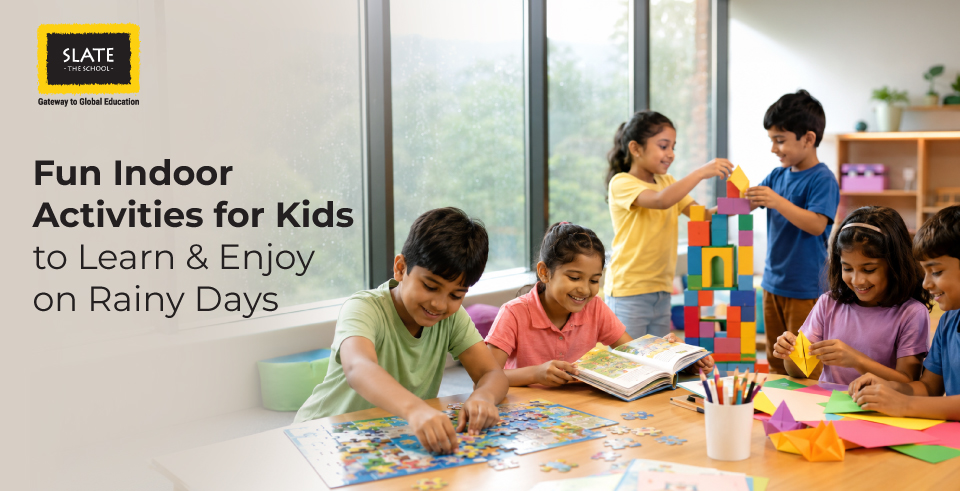
Rainy days can change a child’s entire routine. Outdoor games may have to wait, school activities may look different and children can quickly start saying, “I’m bored.”
But a rainy day does not have to mean a day spent in front of a screen.
With a little creativity, home can become a place for children to play, make things, experiment, read and learn. The best activities do not have to be expensive or complicated. A few simple things around the house can keep children busy for hours while also helping them develop useful skills.
From creative projects and simple science experiments to board games and storytelling, here are some fun indoor activities for kids that can turn a rainy day into a day worth remembering.
1. Build a Blanket Fort
Give children some blankets, pillows, cushions and chairs and let them build their own little fort.
Once the fort is ready, they can turn it into a reading corner, pretend campsite or secret clubhouse.
This simple activity encourages children to use their imagination, plan where things should go and work together if they are building it with siblings or friends.
You can make it even more fun by giving them a challenge: “Can you build a fort that can fit three people?”
2. Try a Treasure Hunt at Home
A treasure hunt can turn an ordinary room into an adventure.
Hide a small toy, book or object somewhere safe in the house and create simple clues for children to follow.
For younger children, use clues based on colours or objects:
“Look for something that is blue.”
“Your next clue is near something you use to sleep.”
Older children can solve simple riddles or puzzles to find the next clue.
Apart from being fun, treasure hunts can encourage children to read, think, remember information and solve problems.
3. Make Your Own Board Game
Why only play board games when you can create one?
Give children paper, cardboard, pencils, dice and small objects that can be used as playing pieces.
Ask them to design their own game.
They can decide:
- What is the goal?
- How many players can play?
- What happens when someone lands on a certain square?
- How does someone win?
This is one of the best DIY activities for kids at home because children get to create the game and then play it.
It also introduces basic ideas about rules, numbers, planning and problem-solving.
4. Have an Indoor Obstacle Course
Move a few safe objects around a room and create a simple obstacle course.
Children can crawl under a table, walk around cushions, jump over a line or balance along a safe path.
Make sure the area is clear of sharp or breakable objects.
You can make it more interesting by giving them different challenges:
“Jump five times.”
“Walk backwards to the cushion.”
“Balance on one foot for five seconds.”
Indoor obstacle courses are great indoor games for kids because they allow children to stay active even when they cannot go outside.
5. Create a Story Together
Start with one sentence:
“One morning, a little girl opened her window and saw a spaceship in the garden.”
Then let your child continue the story.
You can take turns adding one sentence at a time.
You could also give them three random words that must appear in the story, such as “elephant”, “rainbow” and “robot”.
This activity helps children practise language, imagination and communication while giving them the freedom to create their own world.
6. Make a Rainy-Day Art Corner
You do not need expensive art supplies to create something interesting.
Give children paper, old newspapers, cardboard boxes, colours, glue and safe craft materials.
They can make:
- Paper animals
- Greeting cards
- Masks
- Collages
- Paper flowers
- Bookmarks
- Simple puppets
This is another easy example of DIY activities for kids at home.
The focus should not be on making something perfect. Let children experiment with shapes, colours and ideas.
7. Conduct a Simple Science Experiment
Rainy days are a great time to introduce children to simple science.
One easy activity is the floating and sinking experiment.
Fill a bowl with water and collect safe household objects such as a spoon, pencil, plastic bottle cap and small toy.
Before putting each object into the water, ask:
“Do you think it will float or sink?”
Then test the prediction.
Children can make a small list of their predictions and results.
This turns play into a simple science lesson and encourages children to observe, predict and ask questions.
8. Create a Mini Indoor Garden
You do not need a large garden to teach children about plants.
Use small containers, soil and seeds that are suitable for growing indoors.
Let children put the soil into the container, plant the seeds and label them.
They can keep a simple plant diary and record changes every few days.
They might write:
“Day 1: Planted the seed.”
“Day 5: A small shoot appeared.”
“Day 10: The plant has two leaves.”
This activity teaches children about patience, observation and how plants grow.
9. Have a Family Cooking Challenge
Cooking can become a fun learning activity for children when adults handle the tasks that involve heat and sharp tools.
Children can help measure ingredients, mix things, decorate food or arrange a simple snack.
You could even create a small challenge:
“Can you make a snack using three ingredients?”
“Can you arrange these fruits into a funny face?”
Cooking introduces children to numbers, measurements, following instructions and making choices.
It also gives them a chance to become more comfortable around food.
10. Play Indoor Games With the Family
Sometimes the simplest activities are the most enjoyable.
Bring out board games, puzzles, cards or simple games that everyone can play together.
You can also play games that need almost no equipment.
Try:
- Simon Says
- Charades
- Memory games
- Guess the Object
- Musical Statues
- Pictionary
- Twenty Questions
These indoor games for kids can help children practise communication, memory, listening and teamwork while spending time with family.
11. Make a DIY Musical Instrument
Have some empty boxes, paper cups or containers at home?
Use them to make simple pretend instruments.
Children can create a shaker using a sealed container filled with dry rice or pulses. They can decorate a cardboard box and pretend it is a drum.
Once everyone has an instrument, start a small family music session.
Children can create their own rhythm or make up a song about the rainy weather.
Always make sure small objects are kept away from very young children who may put them in their mouths.
12. Turn Reading Into an Adventure
Reading does not have to mean sitting silently with a book for an hour.
Create a cosy reading corner using pillows and blankets.
Let children choose a story and then ask them questions about it.
“What do you think will happen next?”
“Which character would you like to meet?”
“What would you do if you were in the story?”
For younger children, parents can read aloud and encourage them to point at pictures or repeat words.
Reading can become one of the simplest rainy day activities for kids at home while also supporting language and imagination.
13. Create a Family Quiz
Make a simple quiz with questions based on things your child enjoys.
You can include animals, sports, cartoons, science, geography or general knowledge.
For example:
“Which planet is known as the Red Planet?”
“How many legs does a spider have?”
“Which animal is known as the king of the jungle?”
Older children can also create questions for parents.
This makes the activity more interactive and gives children a chance to become the quizmaster.
14. Make a Recycled Art Project
Before throwing away cardboard boxes, paper rolls or old newspapers, see if children can turn them into something new.
A cardboard box could become a house.
A paper roll could become a rocket.
Old newspapers could become part of a collage.
This teaches children that objects do not always need to be thrown away after one use.
It also gives them an opportunity to think creatively and find new uses for everyday things.
15. Have a Family Talent Show
End the rainy day with a little family talent show.
Children can sing, dance, tell jokes, perform a magic trick, read a poem or act out a short scene.
Parents can participate too.
The idea is not to judge who is the best. It is simply about giving everyone a chance to perform, laugh and enjoy time together.
For children, activities like this can help build confidence and communication skills.
Why Indoor Activities Are Important for Children
Indoor activities are not just a way to keep children busy when they cannot go outside.
The right activities can help children develop different skills.
A puzzle can support problem-solving.
A craft project can encourage creativity.
A board game can teach children about rules and patience.
Cooking can introduce numbers and measurements.
Reading can strengthen language skills.
Building something can encourage planning and curiosity.
The best part is that children do not always realise they are learning.
They are simply playing.
Making Rainy Days Less Boring at SLATE – The School
A child’s learning should not stop when the weather changes. Schools can play an important role in helping children develop interests beyond textbooks so they have different ways to learn, explore and stay active.
SLATE – The School follows a broader approach that combines academics with activities such as sports, music, arts and crafts, theatre, swimming, yoga, field trips and life-skills programmes.
This kind of approach is useful because children need different experiences to discover what they enjoy.
SLATE also focuses on learning through activities and practical experiences rather than making education only about memorising information. Its Cambridge curriculum approach encourages children to develop skills such as critical thinking, creativity, communication and problem-solving.
For example, a science lesson can become an experiment, an art concept can become a creative project and a classroom discussion can turn into a group activity.
The school’s TRISHUL framework also focuses on academics, communication, confidence, emotional resilience, human values and life skills.
For parents, this approach can be valuable because it encourages children to learn through different experiences rather than depending only on textbooks or screens.
Final Thoughts
Rainy days do not have to mean endless cartoons, video games or complaints about being bored.
With a few simple materials and a little imagination, parents can turn an ordinary day at home into something children will remember.
Try a treasure hunt. Build a fort. Make a board game. Cook together. Read a story. Create something from old cardboard. Or simply play a silly family game.
The best rainy day activities for kids at home do not need to be expensive or complicated. They just need to give children a chance to move, think, create, talk and have fun.
So the next time the rain keeps everyone indoors, instead of asking, “What will the kids do today?”, try asking:
“What can we create today?”
That one question could turn a boring rainy day into an adventure.
FAQ:
1. What are some fun indoor games for kids on rainy days?
Kids can play board games, puzzles, treasure hunts, charades, or indoor bowling. These indoor games for kids are simple, fun, and easy to enjoy at home.
2. How to entertain your kids on a rainy day?
Try storytelling, baking, dancing, reading, drawing, or building with blocks. These rainy day activities for kids at home keep children busy while making the day more enjoyable.
3. What are some fun crafts kids can make on a rainy day?
Kids can make paper animals, greeting cards, paper puppets, bookmarks, or simple paintings. DIY activities for kids at home are a fun way to encourage creativity.
4. What are some fun indoor games to play with kids at home?
Try hide-and-seek, Simon Says, musical statues, indoor scavenger hunts, or balloon games. These Fun indoor activities for kids can keep them active even when they cannot play outside.
5. How can rainy-day activities support children’s learning and growth?
Rainy-day activities can improve creativity, problem-solving, communication, and teamwork. Games, crafts, and stories can turn free time into enjoyable learning experiences.