There’s a moment every summer when the excitement fades just a little. The first few days feel free and light, but then the hours stretch. Children start drifting between screens, snacks, and small bursts of boredom. It’s not a problem exactly, but it does make one pause and think about how these weeks could feel a bit more meaningful without turning them into another school term. That’s where summer holiday activities for students quietly become important. Not as a strict plan, but as a gentle direction.
Something that keeps their minds moving without taking away the feeling of summer. At SLATE The School, this is something we think about often, because learning was never meant to pause completely. It just needs to look different.
Let Them Build Something Slowly
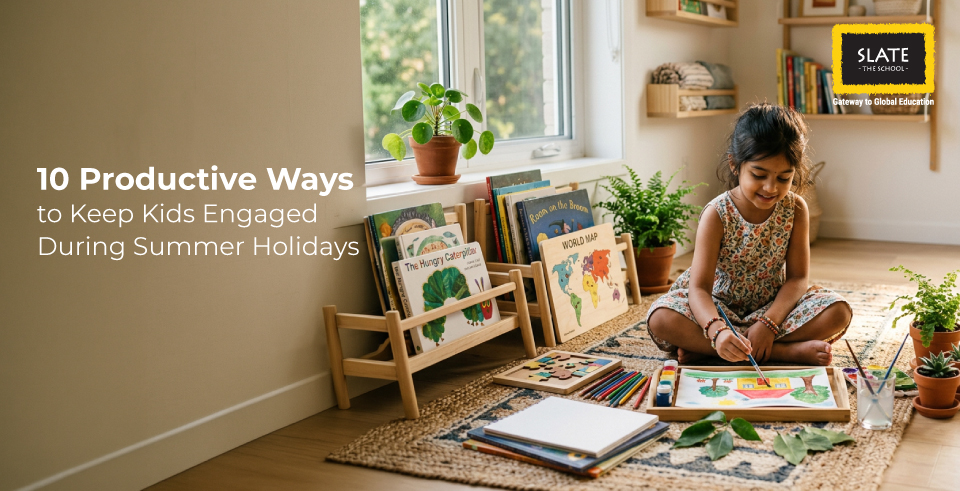
Children don’t always need ready-made games. Sometimes, giving them materials and time is enough. It could be cardboard, old boxes, or even just paper and colours. They begin with nothing and slowly create something that feels like theirs.
There’s a quiet kind of focus in this. No rush, no instructions. Just small decisions building into something bigger. These kinds of productive summer activities for children don’t feel like effort, but they stay with them longer.
Reading That Doesn’t Feel Like Homework
Reading in summer works best when no one is forcing it. A book picked out of curiosity feels different from one assigned. It might be a comic, a story, or something they don’t fully understand yet. That’s fine. The point isn’t mastery. It’s comfort with words, imagination, and time spent in a different world. At SLATE The School, we often see how children who read freely become more thoughtful without even realising it.
Small Responsibilities At Home
There’s something about being trusted with small tasks. Not chores in the strict sense, but things that feel meaningful, watering plants, organising a shelf, helping in the kitchen. It’s not about keeping them busy. It’s about helping them feel capable. These quiet routines shape habits in ways that structured lessons sometimes can’t.
Time Outdoors That Isn’t Rushed
Summer and outdoor time seem obvious together, but it doesn’t have to be planned sports or activities. Just being outside matters, like walking, observing, noticing small things, the way shadows move, how trees look different at different times of day. These moments don’t look productive from the outside, but they settle the mind in a way screens never do. And somehow, they become the most memorable fun activities for kids in summer.
Creative Expression Without Judgement
Children naturally draw, dance, sing, or act out stories. But they often stop when they feel judged or corrected too early. Summer can be a space where that pressure disappears. Let them paint without worrying about staying inside lines. Let them make up stories that don’t make perfect sense. At SLATE The School, we’ve always believed creativity grows best when it isn’t constantly measured.
Learning Through Simple Experiments
Curiosity shows up in small ways. Why does something float? Why does ice melt faster in one place? These questions don’t need formal answers. Simple experiments at home can quietly introduce thinking patterns that stay for years. This connects closely with how we approach learning through our SMAART Program, where curiosity is not rushed but explored. Even basic exploration can be the start of something deeper.
Keeping Social Connections Alive
Summer can sometimes feel isolating if children are mostly at home. Meeting friends, even casually, makes a difference. Conversations, shared games, even disagreements, all of it teaches something. These interactions shape emotional understanding in ways structured environments often don’t.
Encouraging Quiet Time
Not every moment needs to be filled. In fact, some of the best thinking happens in stillness. Letting children sit with boredom sometimes isn’t a bad thing. It pushes them to find their own ideas. It’s easy to overlook this, especially when planning summer activities for kids, but quiet time might be the most important part of all.
Introducing Light Skill-Based Activities
This doesn’t mean formal classes or heavy schedules, just small introductions. Basic coding games, simple puzzles, or even learning how to organise thoughts through journaling. At SLATE The School, we see how early exposure to structured thinking, even in small doses, builds confidence later. It doesn’t have to be intense to be useful.
Letting Them Explore Their Own Interests
Every child leans towards something. It might not always seem “useful” at first. Some like taking things apart. Others enjoy storytelling or observing nature. Summer is a good time to let those interests breathe a little. Instead of redirecting too quickly, it helps to watch. Often, what looks like a passing interest turns into something more meaningful over time.
A Place Where Summer Learning Still Feels Natural
At SLATE The School, we understand that learning does not have to stop when summer begins. It simply changes its shape. Our environment is designed to carry the same curiosity and balance beyond classrooms, where children stay engaged without pressure.
Through thoughtfully planned experiences, creative spaces, and programs like SMAART, we gently guide students to explore, question, and grow. Being among the best Cambridge schools in Hyderabad, we focus on keeping childhood intact while still nurturing skills that matter, even during holidays.
Final Thoughts
None of this needs to be perfect. In fact, trying to make it perfect usually takes away from what summer is meant to be. A mix of structure and freedom seems to work best. Some days will feel productive, others less so. That’s alright. At SLATE The School, the focus has always been on balance. Not just academic growth, but emotional and creative development too. That’s why even outside the classroom, the idea is to nurture curiosity rather than control it. Summer doesn’t need to be filled with constant activity to be valuable. Sometimes, it’s the slower days, the unplanned moments, and the small discoveries that shape children the most, and maybe that’s enough.