
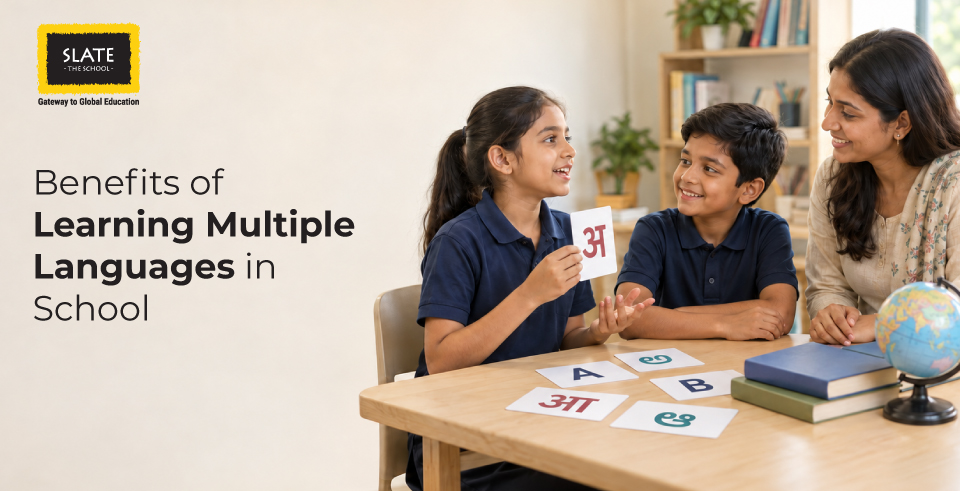
Language is more than a way to communicate. It helps children understand people, express their thoughts and connect with different cultures. When children grow up hearing and using more than one language, they get opportunities to look at the world from different perspectives.
Schools play an important role in making this exposure a natural part of learning. Introducing children to different languages from an early age can help them become more comfortable with communication while also developing social, cultural and thinking skills.
The goal of learning multiple languages for kids should not be to make them memorise vocabulary or grammar rules. Instead, languages should become something they hear, use and enjoy as part of their everyday learning experience.
Why Is Learning Multiple Languages Important?
Children are naturally curious. They learn by listening, observing, repeating and interacting with the people around them. This makes the school environment a useful place to introduce different languages.
The benefits of learning multiple languages can extend beyond simply being able to speak another language. Regular exposure can help children:
- Communicate with a wider range of people
- Understand different cultures
- Become more comfortable expressing themselves
- Develop listening skills
- Build awareness of different ways of thinking
- Strengthen their connection with their mother tongue
- Become more open to different perspectives
Language learning can also become a way of making classrooms more inclusive, particularly in culturally and linguistically diverse communities.
Language Learning Should Start Naturally
Children do not need to master several languages at once. The process should be gradual and suited to their age.
Young children can begin by listening to simple words, songs, stories and conversations. As they become familiar with the sounds and vocabulary, they can slowly start using the language themselves.
This is why language learning for children works best when it is connected to everyday activities rather than treated only as another examination subject.
For example, teachers can introduce a new language through:
- Stories and poems
- Songs and rhymes
- Classroom conversations
- Games
- Art and activities
- Simple instructions
- Cultural celebrations
When children experience a language in different situations, it can become more familiar and less intimidating.
1. It Builds Better Communication Skills
One of the most obvious benefits of learning languages in school is improved communication.
Learning another language encourages children to listen carefully, understand meaning and think about how they express themselves.
They learn that the same idea can sometimes be communicated in different ways depending on the language and situation.
This can make children more thoughtful communicators. They may also become more comfortable speaking to people who have different linguistic or cultural backgrounds.
Schools can support this by creating opportunities for children to speak, listen, read and write regularly instead of focusing only on written tests.
2. It Helps Children Understand Different Cultures
Language and culture are closely connected.
A language can introduce children to stories, traditions, food, music, literature and customs that may be different from their own.
For example, learning a new language through stories can help children understand how families in another region or community live and communicate.
This is one of the important benefits of learning a second language at school. Children are not only learning new words; they are also developing an understanding of the people and cultures connected to those words.
This can encourage respect and curiosity instead of making differences seem unfamiliar.
3. It Encourages Flexible Thinking
When children move between languages, they have to pay attention to words, sentence structures and meanings.
They may learn that there can be several ways to express an idea. This encourages them to think about language rather than simply using it automatically.
For children, this can make language learning an interesting mental exercise.
Teachers can encourage this by asking students to compare simple words or expressions across languages and discuss how meanings may change depending on the context.
4. It Strengthens the Connection With the Mother Tongue
Learning additional languages does not mean that children need to move away from their mother tongue.
In fact, introducing different languages can encourage children to become more aware of their own language.
They may start noticing differences in sounds, words and expressions. They can also develop greater interest in family stories, local literature and cultural traditions.
This is particularly relevant in a multilingual country like India, where children may already hear several languages at home, in their neighbourhood and in their wider community.
The role of school can be to build on this natural linguistic diversity in a structured way.
5. It Builds Confidence
Speaking a new language can feel difficult at first.
Children may make mistakes, forget words or feel unsure about pronunciation. A supportive classroom gives them a safe place to practise without worrying about being perfect.
As they become more comfortable, successfully communicating even a simple thought can give them confidence.
Teachers can encourage this by appreciating effort and participation rather than correcting every small mistake immediately.
The aim should be to help children see mistakes as a normal part of learning.
6. It Improves Listening Skills
Learning another language requires children to listen carefully.
They need to identify unfamiliar sounds, understand words from context and pay attention to tone and expression.
These listening activities can become a regular part of classroom learning through stories, conversations, songs and audio activities.
For younger children especially, listening can be an important first step before they are expected to speak or write extensively.
7. It Makes Children More Comfortable With Differences
Children who regularly encounter different languages may become more familiar with the idea that people can communicate in different ways.
This can help them become more accepting of cultural and linguistic differences.
Schools can support this through multilingual activities, cultural events, storytelling and opportunities for children to share words or expressions from languages they know.
In this way, language becomes part of a broader learning experience rather than an isolated academic subject.
8. It Creates a Stronger Foundation for Future Learning
The ability to communicate in more than one language can be useful as children move through higher education and eventually into professional environments.
However, the value of multilingual education is not limited to future careers.
The bigger benefit is that children grow up with greater exposure to different people, ideas and forms of communication.
The earlier children become comfortable with learning languages, the more natural the process can feel.
What Should Parents Keep in Mind?
Parents do not need to turn language learning into another source of pressure.
A child does not need to speak a new language perfectly from the beginning.
Instead, parents can encourage simple activities such as:
- Reading children’s books in different languages
- Listening to stories or songs
- Learning everyday words
- Talking to family members in the child’s mother tongue
- Watching age-appropriate educational content in different languages
- Encouraging children to ask about unfamiliar words
The most important thing is regular exposure.
If children associate language learning with curiosity and conversation rather than pressure and marks, they are more likely to enjoy the process.
How Schools Can Support Multilingual Learning
The school environment can make language learning much more consistent.
Teachers can introduce languages through classroom conversations, reading activities, storytelling and cultural programmes. Children can also be encouraged to use language in practical situations rather than only completing written exercises.
At SLATE – The School, multilingual early learning is part of its STEP-22 philosophy. The school highlights introducing three languages by age five while strengthening children’s connection with their mother tongue.
SLATE also places emphasis on communication skills through activities that involve listening, speaking, reading and writing. Its language learning approach encourages natural language acquisition rather than relying only on rote learning.
This approach is particularly useful because children get opportunities to use language as part of communication and everyday learning.
SLATE’s broader educational framework also focuses on communication, emotional well-being, life skills and future readiness alongside academics.
For parents looking at learning multiple languages for kids, a school environment where languages are introduced naturally and supported through regular communication can provide a strong foundation.
How Parents and Schools Can Work Together
Language development becomes easier when children receive similar encouragement at school and home.
Parents can speak their mother tongue at home while allowing children to practise other languages introduced at school. They can also ask children to share new words they have learned or tell a story in another language.
Schools, meanwhile, can provide structured opportunities for children to practise those languages with teachers and classmates.
This creates a balance between formal learning and everyday use.
Final Thoughts
The benefits of learning multiple languages go beyond knowing more words. Language can help children communicate, understand cultures, become comfortable with differences and develop a broader view of the world.
The process does not need to be complicated. Children can begin with simple conversations, stories, songs and everyday words. With regular exposure and encouragement, they can gradually become more confident.
The benefits of learning a second language at school are also closely connected to how the language is taught. When children are encouraged to listen, speak, read and explore instead of simply memorising, language learning can become a meaningful part of their education.
Ultimately, learning multiple languages for kids is not about how many languages a child can master. It is about giving them more ways to communicate, connect and understand the world around them.
FAQs:
1. How can multilingual learning benefit children?
The benefits of learning multiple languages include better communication, stronger listening skills, greater confidence and an understanding of different cultures. Learning multiple languages for kids can also make them more comfortable communicating with different people.
2. Does learning multiple languages improve communication skills?
Yes. Language learning for children helps them develop better listening, speaking and communication skills. Learning different ways to express ideas can also make children more confident in conversations.
3. Can language learning support a child’s academic development?
Yes. One of the benefits of learning languages in school is that children practise listening, reading, speaking and understanding regularly. These skills can support learning across different subjects.
4. How does multilingual education encourage cultural awareness?
Learning a new language also introduces children to new traditions, stories and ways of life. This is one of the key benefits of learning a second language at school, as it helps children understand and respect cultural differences.
5. At what age is it beneficial for children to learn additional languages?
Children can start learning additional languages from an early age through simple activities such as stories, songs, and conversations. Early language learning for children can make language exposure feel natural and enjoyable.